


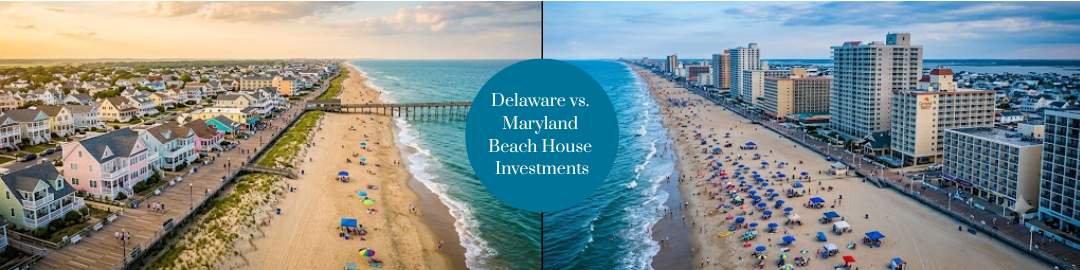
If you're weighing a beach house purchase in Rehoboth Beach, Delaware, or Ocean City, Maryland, the rules for renting it out — and the taxes your guests will pay — are not the same from one town to the next. Both markets welcome short-term rentals, but they license them differently, tax them differently, and enforce the rules differently. For an investor comparing the two, those differences can shift your net income by thousands of dollars a year. Here's what buyers need to know before making an offer on either side of the Delmarva coastline.
The Delaware Rental Landscape, Briefly
Delaware has no statewide rent control and no cap on how often a landlord can raise rent, but coastal towns fill that gap with their own rules. Every rental in the state is subject to a 4.5% State Short-Term Lodging Tax, and municipalities layer on their own tax on top of that — 11.5% total in Rehoboth Beach and Bethany Beach, 9.5% in Lewes and Ocean View, and 7.5% in Dewey Beach. Cities also require business licenses, and in some cases rental inspections, while HOAs and condo boards can impose their own restrictions — minimum stay lengths, caps on how many units in a community can rent short-term, or owner-occupancy requirements. For longer leases, standard tenancy rules apply: landlords must give at least 48 hours' notice before entering a unit (except in an emergency), and rent increases require 30 days' written notice if under 20%, or 60 days' notice if 20% or more.
Rehoboth Beach vs. Ocean City: The Regulatory Snapshot
| Regulatory Factor | Rehoboth Beach, DE | Ocean City, MD |
| Weekly rentals allowed? | Yes | Yes, subject to R-1/MH zone restrictions |
| Primary licenses required | Annual Residential Rental License | Annual Rental License + Noise Permit + Short-Term Rental Supplement |
| Total tax surcharge | 11.5% (flat across all booking channels) | 12% to 15% (varies by booking method) |
| Occupancy formula | 2 people per bedroom + 2 (kids under 7 excluded) | Set by approved bedroom count and designated parking |
| Enforcement style | Annual self-inspections & complaint-driven audits | “Three-strike” suspension policy + 60-minute emergency response agent |
Rehoboth Beach: Straightforward Taxes, Strict Occupancy Math
Rehoboth Beach keeps its rental tax simple: one flat rate no matter how you book the property. Owners need an annual Residential Rental License from the Building and Licensing Department, with a flat $150 renewal fee. New rentals need an initial city inspection, and every renewal after that requires an Annual Self-Inspection Checklist covering the basics — smoke alarms in every bedroom, fire extinguishers on each level, and clear emergency exits.
Occupancy is capped using a simple formula:
Maximum Occupancy = (2 × Number of Bedrooms) + 2
Children six and under don't count toward that limit, which gives families a little breathing room.
On taxes, guests pay a combined 11.5%: a 7.0% city rental tax (billed annually to the owner, due February 15) plus the 4.5% Delaware state lodging tax, collected monthly.
Ocean City: More Licenses, Tiered Taxes, and a Three-Strike Rule
Ocean City runs a more layered system. Operators need a Standard Rental License (roughly $196), a mandatory Noise-Control Permit, and a Short-Term Rental Supplement ($50), putting typical startup costs around $246 before the property ever hosts a guest.
Zoning matters more here too — some R-1 and manufactured housing zones have moratoriums or outright bans on new short-term rental licenses, so it's worth confirming zoning before you make an offer.
Enforcement is tighter as well. Ocean City uses a three-strike policy: three documented noise or non-compliance incidents at one address within 12 months can trigger a 30-day license suspension. Owners must also designate a local contact who can physically reach the property within 60 minutes of a complaint.
Taxes depend on how the stay is booked:
- Maryland State Sales Tax: 6.0%
- Worcester County Lodging Tax: 6.0%
- Ocean City Platform Booking Tax: 3.0% (applies only to bookings made through online marketplaces like Airbnb or Vrbo)
That last piece creates a real loophole: rentals booked directly through a licensed local real estate brokerage skip the 3.0% platform tax. So a guest booking through Airbnb pays 15.0% total, while a guest booking through a local agency pays 12.0%.
Income Potential: What the Numbers Actually Look Like
Both markets are hyper-seasonal — most of the year's income lands in a tight 12-to-16-week window between Memorial Day and Labor Day.
Rehoboth Beach commands higher nightly rates but lower year-round occupancy (around 21% to 25% annually, thanks to quiet winters):
- 3-bedroom homes: roughly $56,800 in annual revenue, with an ADR near $294
- 4-bedroom homes: roughly $107,400 annually, with an ADR near $572
- 6+ bedroom luxury estates: over $700/night, generating upwards of $207,000 annually
A well-located 4- or 5-bedroom home can bring in more than $15,000 in a single July or August month alone.
Ocean City leans on high-density condo inventory. A standard 3-bedroom condo might rent long-term for around $2,500/month, but during peak summer weeks, that same unit can command $3,500 to $5,000+ per week. May and September are growing shoulder months tied to regional events and golf packages, while weekly rates drop by more than half once October arrives.
For both markets, expect 60% to 70% of your total annual gross income to land inside an 85-day window. Add in property management fees, which typically run 10% to 30% for full-service, turn-key coastal management, and you get a much clearer picture of true net operating income than the headline revenue numbers alone.
Frequently Asked Questions
Is there rent control in Delaware or Maryland's coastal towns?
No. Neither state caps how much or how often rent can be raised for standard leases. Delaware requires 30 days' notice for increases under 20% and 60 days' notice for increases of 20% or more.
Which town has the lower total tax rate for short-term guests?
Rehoboth Beach's flat 11.5% is lower than Ocean City's platform-booked rate of 15.0%, though Ocean City drops to 12.0% for stays booked directly through a local real estate brokerage.
Can an HOA block me from renting my beach house short-term?
Yes. Delaware doesn't prohibit homeowners from renting, but HOAs and condo boards can impose minimum lease lengths, cap the number of units allowed to rent short-term, or require owner occupancy.
What happens if a rental property racks up too many complaints in Ocean City?
Three documented non-compliance or noise incidents at one address within 12 months can trigger a 30-day suspension of the rental license under the town's three-strike policy.
Do children count toward occupancy limits in Rehoboth Beach?
Children age six and under are excluded from the occupancy formula of (2 × bedrooms) + 2, giving families some extra flexibility.
Which market generates more predictable income, Rehoboth or Ocean City?
Rehoboth trades higher per-night rates for a shorter, more concentrated season. Ocean City's condo-heavy inventory offers more shoulder-season demand tied to events and golf packages, which can smooth out the income curve somewhat, though both markets still concentrate the bulk of revenue in an 85-day summer window.
Thinking About Buying on the Delaware or Maryland Coast?
Regulations, taxes, and income potential vary block by block along this coastline, and the right property depends on your goals — cash flow, appreciation, or a mix of both. The Real McCoy Group of Coldwell Banker Realty knows the local zoning maps, licensing requirements, and revenue data for Rehoboth Beach, Lewes, Bethany Beach, and the surrounding Delmarva markets inside and out. Reach out today to talk through which coastal investment fits your strategy.
Disclaimer
This article is provided for general informational purposes only and does not constitute legal, tax, financial, or real estate advice. Rental licensing fees, tax rates, occupancy formulas, zoning designations, and enforcement policies referenced above are subject to change at any time by the City of Rehoboth Beach, the Town of Ocean City, Worcester County, Sussex County, the State of Delaware, and the State of Maryland. Revenue figures, average daily rates, and occupancy percentages are estimates drawn from third-party market data and are not a guarantee of future performance for any specific property. Before purchasing, licensing, or operating a short-term or long-term rental, readers should verify current requirements directly with the relevant municipal, county, and state agencies and consult a licensed attorney, tax professional, and/or real estate agent. The Real McCoy Group of Coldwell Banker Realty and the author of this article assume no liability for decisions made based on the information presented here.
Sources
- City of Rehoboth Beach, DE — Residential Rental License
- City of Rehoboth Beach Municipal Code — Chapter 210: Residential Rentals (eCode360)
- Town of Ocean City, MD — Division of Rental Housing
- Town of Ocean City, MD — New Licenses, Finance Department
- Avalara MyLodgeTax — Ocean City, Maryland, ends short-term rental moratorium in residential districts
- Avalara MyLodgeTax — Ocean City, Maryland, halts new short-term rental permits in residential zones for another year
- CoastTV — Ocean City Council approves short-term rental regulations
- Delaware Division of Revenue — State Lodging Tax (4.5%, effective January 1, 2025)
- Delaware Residential Landlord-Tenant Code (Title 25, Delaware Code) — notice-of-entry and rent-increase notice provisions
Note: Tax rates, fees, and moratorium statuses referenced in this article reflect information available as of mid-2026 and should be independently verified, as they are subject to change by the relevant governing bodies.


Social Links Header